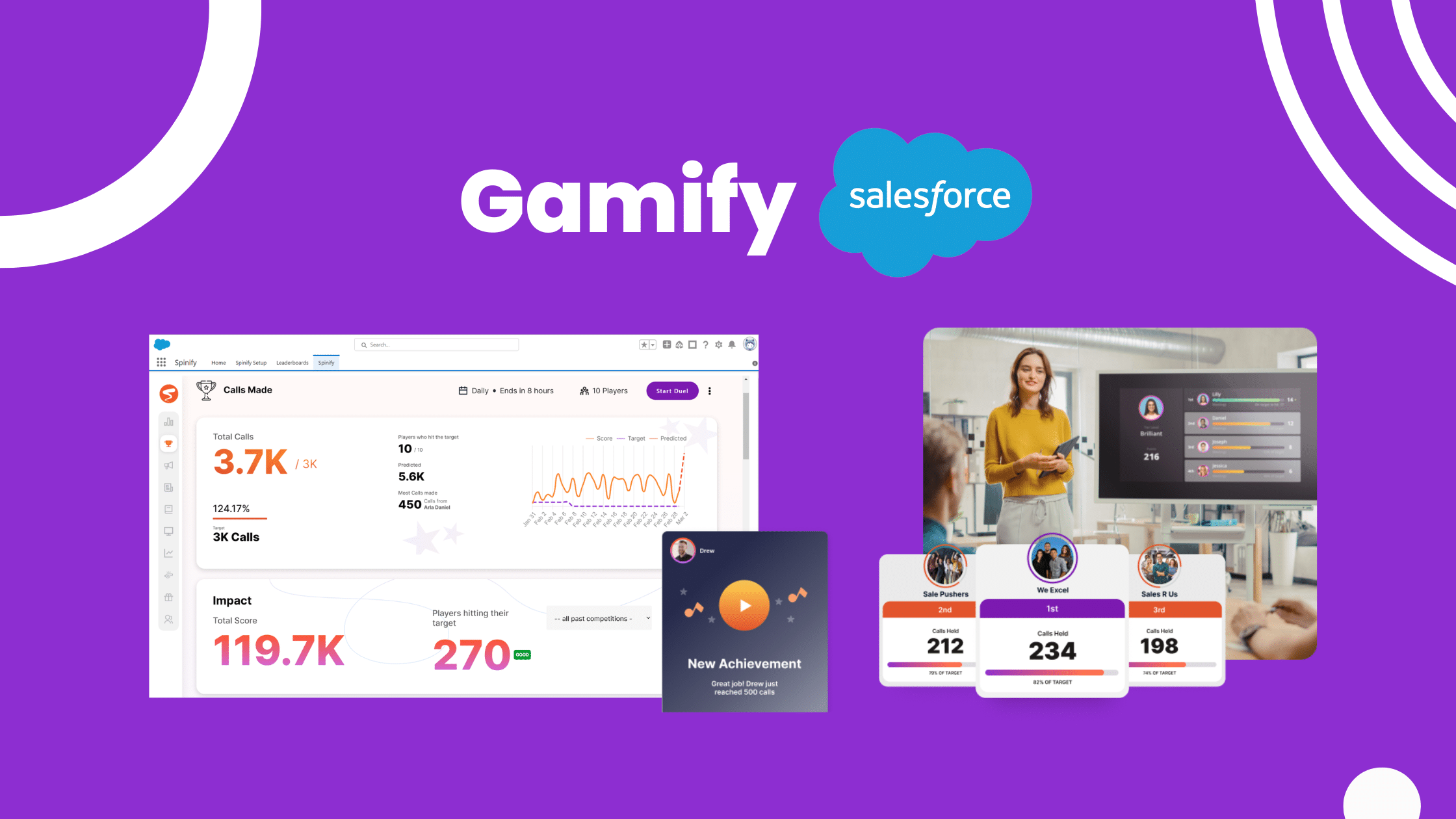
Salesforce gamification transforms CRM adoption by incorporating game mechanics—points, badges, leaderboards, and competitions—directly into your sales workflow. This approach makes routine Salesforce activities engaging, driving user adoption, improving data quality, and boosting overall sales performance.
For sales leaders, Salesforce admins, and revenue operations teams struggling with low CRM adoption rates or inconsistent data entry, gamification offers a proven solution. Studies show that gamified Salesforce implementations see 30-40% higher user adoption and 25% improvements in data quality.
What you’ll learn in this comprehensive guide:
- What Salesforce gamification is and how it works (with real examples)
- Core benefits: increased adoption, better data quality, higher productivity
- Step-by-step implementation guide for Spinify + Salesforce integration
- Difference between gamification platforms and native CRM tools
- Advanced tactics for sustaining engagement long-term
- ROI measurement and success metrics
Whether you’re launching Salesforce for the first time or trying to revitalize a stagnant implementation, this guide provides actionable strategies to drive adoption and improve sales performance through gamification.
What is Gamification for Salesforce and How Does It Work?
Gamification for Salesforce involves incorporating game mechanics—like points, badges, leaderboards, goals, and statuses—into the Salesforce platform. This approach transforms routine activities into engaging experiences that stimulate competition, reward progress, and make learning enjoyable.
How It Works:
- Integration of Game Mechanics: By embedding elements such as leaderboards and badges within Salesforce, employees receive immediate feedback and recognition as they progress.
- Motivation Through Competition: Leaderboards and point systems encourage healthy competition among sales teams, increasing productivity and focus.
- Rewards and Recognition: Achieving set goals triggers rewards, which can be virtual badges, points, or tangible incentives—reinforcing desired behaviors.
Core Benefits:
- Increased User Adoption: Engaging and interactive methods encourage employees to fully embrace Salesforce, reducing resistance to change and facilitating smoother transitions.
- Enhanced Learning and Retention: Game-based learning promotes better understanding and retention of complex Salesforce features and workflows.
- Boosted Productivity: Motivation from gamified processes leads to higher productivity, as employees strive to achieve goals and outperform peers.
- Improved Employee Morale: Recognition and rewards foster a positive work environment, leading to happier, more engaged teams.
- Actionable Insights: Real-time tracking and feedback from gamification tools provide valuable insights into team performance, guiding strategic decisions.
By applying these principles, businesses can transform their Salesforce experience, turning everyday tasks into engaging challenges that drive sustained success.
Leveraging Gamification in Salesforce: What It Is and How to Use It
Gamification is an innovative strategy embraced by forward-thinking businesses to enhance customer and employee engagement. By embedding game mechanics into Salesforce, companies create dynamic environments that challenge and reward users, leading to deeper learning experiences and higher motivation.
This approach taps into the natural human affinity for challenges, offering rewards for achievements. Effective Salesforce gamification can significantly boost user adoption and enrich learning by keeping the mind engaged and motivated. Rewards—ranging from a dopamine rush to game mechanics recognition—help sustain interest and participation over time.
The key to successful gamification in Salesforce lies in the strategic use of game mechanics. These elements, such as points, badges, and leaderboards, serve as psychological incentives that maintain user interest and drive progress. By rewarding achievements and milestones, these mechanics not only encourage continued use but also pave the way for improved user experience and tangible business outcomes.
Ultimately, applying gamification in Salesforce transcends basic engagement. It involves a cohesive set of processes and activities that leverage game mechanics to solve challenges, enhance user interactions, and achieve specific business goals—making it an essential tool for modern organizations looking to boost productivity and adoption.
Incorporating gamification tools like Spinify within Salesforce not only enriches customer interaction but also empowers sales reps by making their targets achievable and rewarding, thereby enhancing the overall Salesforce gamification strategy.
Difference Between a Sales Gamification Platform and CRM
Gamification and CRM are both important tools that companies can use to get ahead. However, they both have their own benefits and serve different purposes.
· Gamification
Gamification is a technique through which companies manage to engage consumers with their services and products. This allows the consumers to interact with the companies on a deeper level and better understand the company, its products, and its purpose. This is because when users interact with a company through gamification, they end up learning what the best way to interact with the company is.

· CRM
While gamification allows the consumer to interact with a company and better understand it, CRM allows the company to learn more about its consumers and gain a deeper understanding of them. The system allows companies to obtain personal information of its users like their purchase history, buying preferences, interaction history, and buying patterns, among other things. This information allows the company to interact with its customers in an efficient manner.
Why Spinify is the Ideal Gamification Solution for Salesforce
Spinify is a revolutionary web-based gamification platform designed to boost workplace productivity and employee engagement by integrating seamlessly with Salesforce and other platforms. Enhanced with AI capabilities, and seamless integration with several tools Spinify facilitates real-time performance tracking and goal setting. Its innovative integration and AI features streamline workflows and offer actionable insights, making it an essential tool for modern businesses aiming to enhance their team’s performance.
- Seamless Integration and Ease of Setup
Spinify stands out as the perfect tool for Salesforce users, offering seamless integration that transforms sales data into actionable insights without the need to switch platforms. This integration not only simplifies access to real-time data and metrics but also boasts features like Single Sign-On (SSO) and the ability to backdate data up to 90 days or more, making setup effortless and fast.
- Enhancing Performance through Gamification
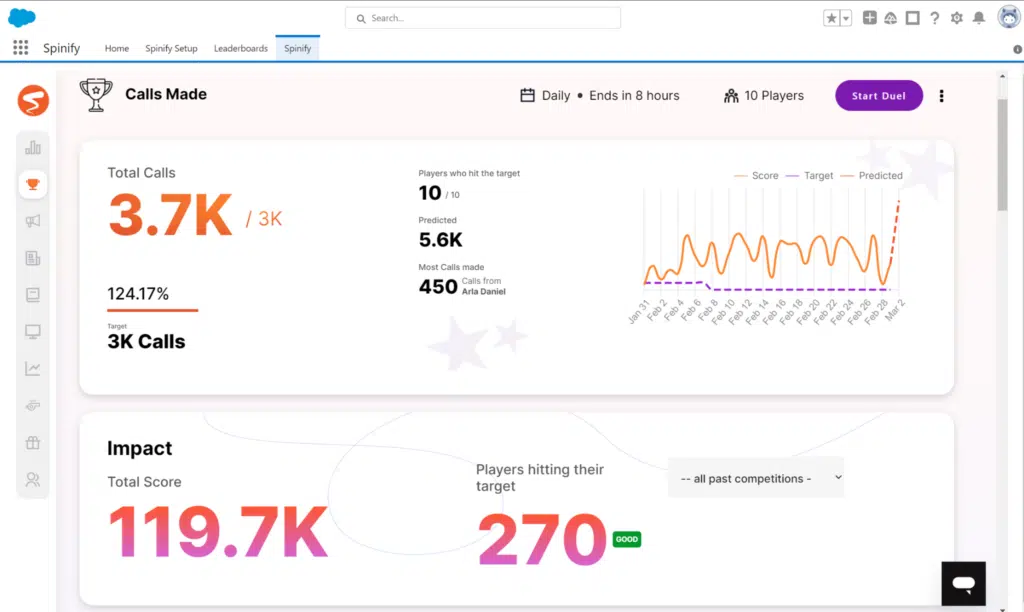
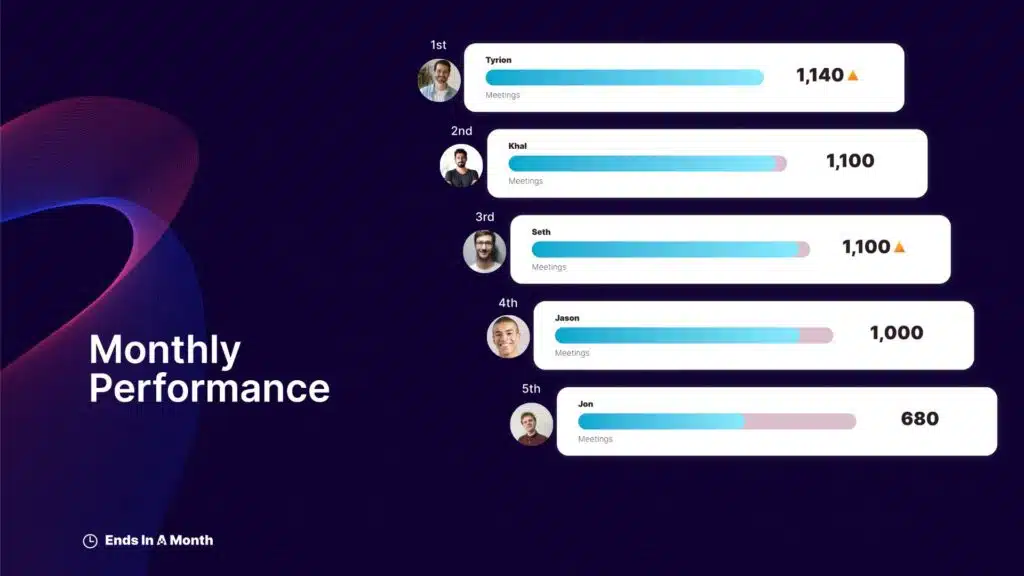
The application of gamification techniques by Spinify motivates sales teams by incorporating leaderboards, achievements, and competitions directly within Salesforce. This method incentivizes sales reps to elevate their performance and achieve targets, embedding a culture of continuous improvement and engagement.
- Customization to Meet Unique Organizational Needs
Spinify allows Salesforce customers to tailor their dashboards and leaderboards, aligning them with specific sales goals and metrics. This customization ensures that the platform serves the unique needs of each organization, making it a versatile tool for various business models.
- Real-time Updates for Informed Decision-Making
With Spinify, sales managers receive real-time updates on team performance, enabling them to monitor progress and adapt strategies promptly. This feature ensures that sales teams can quickly respond to changes and opportunities, maximizing their potential for success.
- Boosting Engagement with Interactive Features
Spinify boosts employee engagement by rendering sales performance transparent and interactive. Personalized achievements and recognitions make sales reps feel valued, fostering a motivated and productive work environment.
- Dynamic Data Visualization for Enhanced Insights
The platform offers advanced data visualization tools that simplify the process of identifying trends and opportunities within Salesforce data. These visualizations assist sales teams in comprehensively understanding their performance metrics and identifying areas for improvement.
Step-by-Step Salesforce Gamification Implementation Roadmap
Successfully implementing gamification in Salesforce requires more than just turning on a tool. Follow this proven roadmap to drive adoption and sustainable results:
Phase 1: Assessment & Goal Setting (Week 1-2)
Objective: Identify current challenges and define success metrics
Key activities:
- Audit current Salesforce usage: Measure baseline adoption rates, login frequency, data entry consistency, and pipeline hygiene
- Identify pain points: Where are users resisting? Common issues include incomplete records, delayed updates, low activity logging
- Define SMART goals: Example: “Increase daily Salesforce logins from 60% to 85% within 90 days” or “Improve opportunity data completeness from 70% to 90%”
- Stakeholder alignment: Get buy-in from sales leadership, IT/Salesforce admin team, and frontline managers
Phase 2: Platform Selection & Integration (Week 2-3)
Objective: Choose the right gamification platform and integrate with Salesforce
Key activities:
- Evaluate platforms: Spinify offers native Salesforce integration, real-time data sync, SSO, and 90+ day data backdating
- Technical setup: Connect Spinify to Salesforce using pre-built connectors (typically 15-30 minutes setup time)
- Data mapping: Define which Salesforce objects and fields to track (Opportunities, Activities, Contacts, Custom Objects)
- Test integration: Verify data flows correctly between Salesforce and gamification platform
Phase 3: Game Mechanics Design (Week 3-4)
Objective: Create compelling game mechanics aligned with business goals
Key activities:
- Design leaderboards: Create both individual and team boards tracking key metrics (calls made, opportunities created, deals closed)
- Configure achievements/badges: Award badges for milestones like “First Deal Closed,” “10 Meetings Booked,” “Pipeline Champion”
- Set up competitions: Launch time-bound contests (weekly, monthly, quarterly) with clear rules and attractive rewards
- Establish point systems: Assign point values to desired behaviors (10 pts for logged call, 50 pts for created opp, 200 pts for closed deal)
Phase 4: Pilot Launch (Week 5-6)
Objective: Test with a small group before full rollout
Key activities:
- Select pilot team: Choose 10-20 reps representing different experience levels and personalities
- Provide training: 30-minute onboarding session explaining how gamification works and how to earn points/badges
- Launch kickoff event: Generate excitement with an initial competition and prizes
- Gather feedback: Weekly check-ins to identify what’s working and what needs adjustment
Phase 5: Full Rollout & Optimization (Week 7-12)
Objective: Scale to entire sales organization and refine based on data
Key activities:
- Company-wide launch: Roll out to all Salesforce users with clear communication and training resources
- Monitor engagement: Track participation rates, which competitions drive most engagement, which rewards motivate best
- Iterate game mechanics: Refresh leaderboards monthly, introduce new badges quarterly, vary competition formats
- Measure business impact: Compare pre/post metrics on adoption, data quality, sales velocity, and revenue
Phase 6: Sustain & Scale (Ongoing)
Objective: Maintain momentum and expand gamification beyond sales
Key activities:
- Regular refreshes: Introduce seasonal themes, new competition types, evolving achievements to prevent staleness
- Recognition events: Monthly awards ceremonies, quarterly top performer spotlights, annual leaderboard champions
- Expand to other teams: Apply gamification to customer success, marketing, support teams using Salesforce
- Continuous improvement: Quarterly reviews of what’s working, user feedback sessions, A/B testing of new mechanics
🚀 Quick Win Tip: Start with a 30-day “Salesforce Data Quality Challenge” focusing on one simple metric like “Complete all opportunity fields.” This narrow focus creates immediate success, builds momentum, and demonstrates ROI before expanding to more complex gamification. Spinify’s templates make launching these challenges easy with pre-built configurations.
The Ease of Integrating Spinify with Salesforce
- Native Integration for Seamless Compatibility
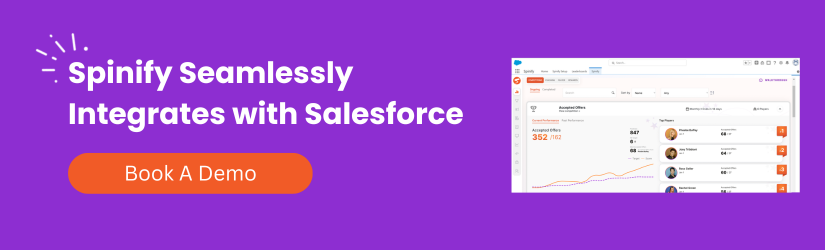
Spinify’s design for seamless integration with Salesforce, leveraging APIs and data structures for smooth data exchange, ensures compatibility and efficient operation between the two platforms.
- Simplified Setup with Pre-built Connectors
Offering pre-built connectors tailored for Salesforce, Spinify simplifies the integration process. These connectors allow for quick and easy setup without the need for in-depth technical knowledge or custom development.
- User-friendly Configuration Wizard
A configuration wizard guides users through the integration process, simplifying setup by automatically detecting Salesforce instances and facilitating authentication and permission settings.
- Automatic Data Syncing for Up-to-date Information
Once integrated, Spinify ensures that data from Salesforce is automatically synced in real-time or at scheduled intervals, keeping sales teams informed with the latest information without manual updates.
- Customization for Specific Organizational Requirements
Spinify provides extensive customization options, allowing users to select specific Salesforce objects and fields for syncing, ensuring that leaderboards and dashboards display only relevant data.
- Comprehensive Support and Documentation
To assist with the integration process, Spinify offers detailed documentation, tutorials, FAQs, and dedicated support channels, ensuring users have the resources needed to address any issues.
Facilitating Salesforce Adoption with Spinify
Intuitive Interface for Easy Navigation
Spinify’s user-friendly interface ensures easy navigation and understanding, reducing the learning curve for new users and enhancing user adoption.
Guided Setup for Quick Implementation
With a guided setup process, Spinify walks users through connecting to data sources, customizing leaderboards, and setting up goals and metrics, facilitating a quick and efficient start.
Ready-to-use Templates for Ease of Customization
Spinify’s pre-built templates for leaderboards, achievements, and competitions can be easily customized, saving time and effort for users unfamiliar with creating gamification systems from scratch.
Scalability to Accommodate Growth
Designed to be scalable, Spinify can adapt to the needs of both small sales teams and large enterprises, supporting organizations as they grow and evolve.
For more details on integrating Spinify with Salesforce, visit Spinify’s Salesforce Integration Page.
Measuring Salesforce Gamification Success: Key Metrics & ROI
Demonstrating ROI is critical for sustaining executive support and budget approval. Track these metrics to prove gamification impact:
1. User Adoption Metrics
What to measure:
- Daily Active Users (DAU): Percentage of sales team logging into Salesforce daily
- Feature adoption rate: Usage of specific Salesforce features (reports, dashboards, mobile app)
- Login frequency: Average logins per user per week
- Session duration: Time spent in Salesforce per session
Benchmark: Best-in-class teams see 85-90% DAU post-gamification vs. 50-60% without gamification
2. Data Quality Metrics
What to measure:
- Field completeness: Percentage of required fields filled in opportunities, contacts, accounts
- Data accuracy: Error rates in contact information, opportunity amounts, close dates
- Update frequency: How often records are updated with new information
- Duplicate records: Rate of duplicate creation (should decrease)
Benchmark: Gamified implementations typically improve data completeness from 70% to 90%+
3. Activity & Productivity Metrics
What to measure:
- Activity logging: Calls, emails, meetings logged per rep per week
- Pipeline creation: Number and value of new opportunities created
- Deal progression: Speed of opportunities moving through sales stages
- Task completion rate: Percentage of assigned tasks completed on time
Benchmark: Teams see 30-40% increases in logged activities after implementing gamification
4. Sales Performance Metrics
What to measure:
- Win rate: Percentage of opportunities closed-won
- Average deal size: Revenue per closed opportunity
- Sales cycle length: Days from opportunity creation to close
- Quota attainment: Percentage of reps hitting monthly/quarterly targets
Benchmark: Companies report 15-25% improvements in quota attainment with effective gamification
5. Engagement & Culture Metrics
What to measure:
- Gamification participation rate: Percentage of team actively engaging with leaderboards/competitions
- Competition completion rate: How many users finish active competitions
- Employee satisfaction: NPS or eNPS scores related to Salesforce usage
- Peer recognition: Number of team members giving/receiving kudos or badges
Calculating ROI: Simple Formula
Step 1 – Measure productivity gains:
- Increased opportunities created per month: 50 → 70 = +20 opps
- Average opportunity value: $25,000
- Win rate: 25%
- Additional monthly revenue: 20 × $25K × 25% = $125,000/month = $1.5M/year
Step 2 – Calculate costs:
- Spinify platform cost: ~$50,000/year for 50-person team
- Implementation time: ~40 hours × $100/hr = $4,000
- Total first-year cost: $54,000
Step 3 – ROI calculation:
- ROI = (Gain – Cost) / Cost × 100
- ROI = ($1,500,000 – $54,000) / $54,000 × 100
- ROI = 2,678% or roughly 27x return in year one
💡 Pro Tip: Create a simple dashboard in Salesforce or Excel tracking these metrics monthly. Share it with leadership to maintain visibility on gamification impact. Most organizations see positive ROI within 90 days, with full payback within 6 months. The key is consistent measurement and reporting.
Revitalizing Business Strategies: The Confluence of Gamification, CRM, and Salesforce Gamification
In conclusion, the fusion of gamification and CRM—particularly through Salesforce gamification—demonstrates innovative strategies that foster meaningful interactions between businesses and their audiences. Embracing these tools can significantly impact employee engagement, learning experiences, and overall business outcomes.

By strategically incorporating gamification tools, focusing on employee engagement, and prioritizing user experience, businesses can navigate the complexities of the digital age with Salesforce at the helm.
Dive Deeper into Salesforce Gamification Strategies
This introduction offers a glimpse into the transformative power of gamification for Salesforce. To understand the broader context, core strategies, and success stories, revisit The Ultimate Guide to Gamify Salesforce and Adoption.
Ready to transform your salesforce experience? Book your demo today at Spinify!