In today’s workplace, employee motivation and engagement are key to success, yet keeping teams inspired can be challenging. Gamification adds excitement, purpose, and recognition to everyday tasks by incorporating point systems, leaderboards, and rewards, transforming routine work into an engaging experience. There are a bunch of ways to implement a point system game, and the right idea—such as embedding scoring conditions or customizing objectives—can make all the difference in shaping game mechanics and player experience.
Gamification loyalty programs enhance customer engagement with mobile apps, quizzes, and fixed action rewards, driving repeat purchases and making brand interactions more rewarding.
But why is a points-based system so effective? How can it inspire employees, boost performance, and create a thriving culture? This blog explores gamification’s power in the workplace, showing how rewarding employees with points turns mundane tasks into meaningful milestones. Whether to increase productivity, enhance learning, or make work fun, this guide has the insights you need. It’s important to remember that point systems should be carefully designed to avoid “pointsification,” where users accumulate points without purpose. Thoughtful design ensures that points remain meaningful and drive the desired behaviors. Let’s dive in!
What is Gamification?
Gamification applies game-like elements—points, levels, badges, leaderboards, and rewards—to non-game contexts to boost engagement and motivation. In sports like basketball or darts, as well as in board games, points awarded for specific actions add competition and fuel leaderboards.
Gamification taps into the human desire for achievement and recognition, making routine tasks more engaging. Careful design of point systems is crucial to ensure they motivate the right behaviors and avoid unintended consequences. While popular in loyalty programs, it’s also effective in workplaces and learning environments. Loyalty gamification enhances customer engagement by turning programs into interactive experiences, increasing brand loyalty and conversion rates.
In employee engagement, gamification improves productivity and teamwork by encouraging goal achievement through fun competition. Points systems establish clear goals and track progress, making performance measurable and motivating players. Points systems also help establish clear goals and boundaries, making it easier to track performance and adherence to rules.
Definition and Purpose
Gamification in loyalty programs uses game design to engage customers and encourage behaviors like purchases or referrals. Points, badges, and leaderboards make earning rewards fun and interactive, boosting customer loyalty and brand connection. This approach increases customer participation and long-term engagement.
Main Reasons to Use Gamification
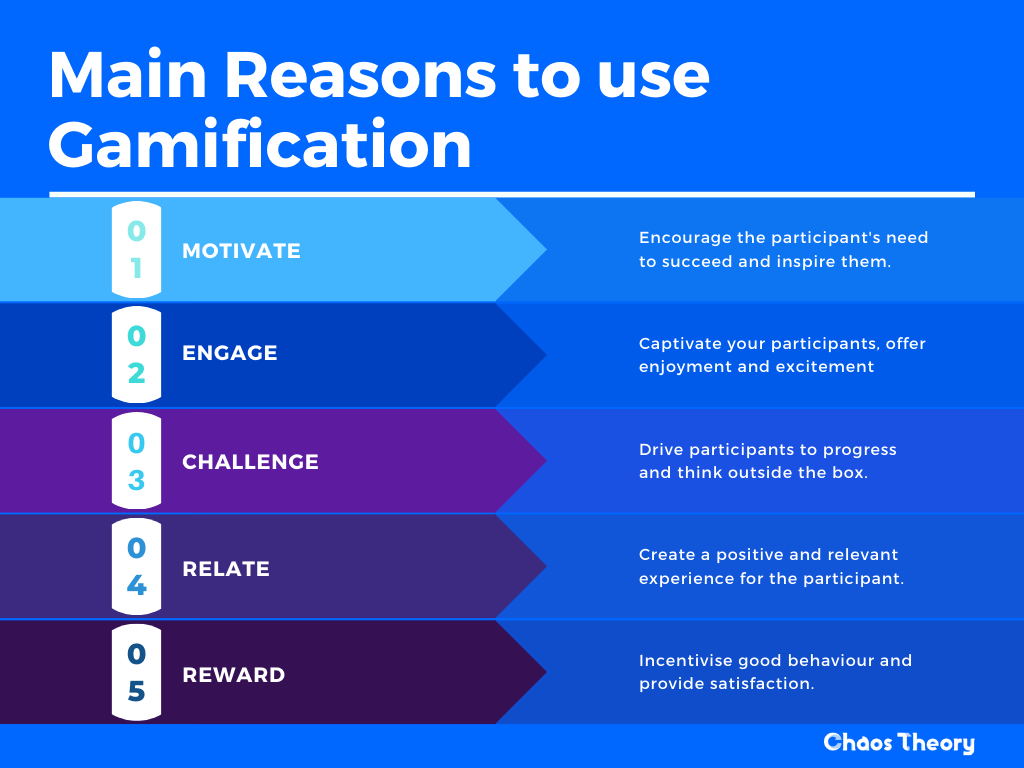
Gamification is not just about making work fun—it’s a strategic tool that drives measurable results for both employees and organizations. Here are the main reasons to use gamification:
Boost Customer Engagement
- Gamification keeps employees actively involved by making tasks feel more rewarding and less routine. Engaged employees are more likely to stay focused and perform at their best.
2. Increase Motivation
- By tying actions to immediate rewards like points, badges, or recognition, gamification creates a sense of achievement that inspires employees to strive for more.
3. Foster Healthy Competition
Leaderboards and team challenges encourage employees to compete in a positive way, driving better performance while strengthening team dynamics. Competing with friends can make the experience more engaging and relatable, as friendly rivalry often motivates participants to push themselves further. Additionally, high scores often create a desire to replay levels or tasks to improve performance, fostering continuous improvement.
4. Improve Learning and Development
- Gamification enhances training programs by making them interactive and enjoyable. Employees retain knowledge better when learning feels like a game rather than a chore.
5. Recognize and Reward Achievements
- Public recognition through gamification builds morale and gives employees a sense of accomplishment. Rewards, whether tangible or virtual, reinforce desired behaviors.
6. Drive Productivity
Gamified tasks encourage employees to meet deadlines, complete projects, or exceed performance goals. Having a clear plan allows employees to use the point system game more effectively, maximizing productivity and helping them achieve their goals. Tracking progress through points or levels helps them stay motivated to finish what they start.
7. Create a Positive Work Culture
- Gamification introduces an element of fun to the workplace, fostering a sense of community and collaboration among employees.
8. Retain Top Talent
- Engaged and motivated employees are more likely to stay with the organization. Gamification adds value to their day-to-day work, creating a sense of fulfillment and belonging.
By incorporating gamification into your organization’s strategy, you can unlock the potential of your team, create a culture of achievement, and drive meaningful results that benefit both employees and the business.
Psychology Behind Gamification
Gamification taps into key human psychology, especially Maslow’s needs: Love and Belonging, Self-Esteem, and Self-Actualization, and a deeper understanding of the psychology of gamification and why it works can help you design more effective point systems. It builds community through leaderboards and social sharing, boosting connection and camaraderie. Earning points and badges enhances self-esteem by providing recognition and accomplishment. At the highest level, gamification drives personal growth by encouraging mastery and unlocking exclusive rewards.
Addressing these needs creates a satisfying experience that motivates customers to engage with the brand, increasing loyalty and long-term interaction.
Loyalty Program Point System for Employees
Understanding why gamification is important and its benefits helps you design point systems that truly align with your organization’s goals and culture.
Gamification uses game features like point systems to motivate employees and drive results, and a dedicated sales gamification platform to engage your team can streamline how you implement these mechanics day to day. Employees earn points for actions such as reaching sales goals, completing training, collaborating, or meeting deadlines.

Points reward achievements, foster healthy competition, and boost morale. They can unlock tangible rewards like gift cards, extra vacation days, or development opportunities.
Points motivate by showing clear progress and accomplishment. Employees stay engaged and perform better when their efforts lead to recognition or rewards. This creates a cycle of continuous growth. Points quantify and recognize individual performance, making the workplace more engaging and fulfilling.
Why do gamification points work?
Gamification points tap into human psychology by creating achievement, progress, and motivation. They leverage goal-setting, instant feedback, and rewards to keep employees engaged. Here’s why they work:
- Clear Goals and Motivation Points give employees tangible success markers, motivating focus and effort. Even a small difference in point allocation can significantly impact employee motivation, as employees notice and respond to these distinctions.
- Instant Recognition Points provide immediate feedback, boosting morale and reinforcing positive actions. Offering quick, granular points for moment-to-moment actions keeps employees engaged, while larger rewards should be reserved for significant milestones.
- Healthy Competition and Social Status Points foster friendly competition via leaderboards, encouraging engagement and showcasing player points.
- Sense of Progression: Accumulating points shows visible growth, fueling purpose and continuous improvement.
- Rewards and Incentives Points lead to rewards that can change value over time, motivating sustained effort.
- Engagement Through Gamification Points make routine tasks enjoyable, creating a dynamic system of recognition.
Adjustable points allow balancing difficulty and steering behaviors.
Where to apply gamification points?
Gamification points work across industries—businesses, marketers, educators, trainers, and app developers can all benefit from this versatile point system game. The developer plays a crucial role in creating and maintaining effective point system games, ensuring ongoing updates, feature improvements, and support for users. Gamification points can be applied to a variety of events, from sales competitions to training sessions, making them useful for tracking and motivating performance in different settings. Point systems are also commonly used in playing games, sports, and other activities to track progress and reward achievement.
Types of Gamification Rewards
Beyond points, understanding the six main types of gamification rewards helps you choose the right incentives to keep employees motivated over time.
Gamification rewards come in various forms and are designed to cater to both intrinsic and extrinsic motivations. Each reward type has its own key features, such as instant feedback, long-term recognition, or tangible incentives, which appeal to different user motivations and preferences. When implementing a gamification strategy for employees, offering a mix of reward types ensures broader appeal and sustained engagement. Here are the main categories of gamification rewards:
1. Tangible Rewards
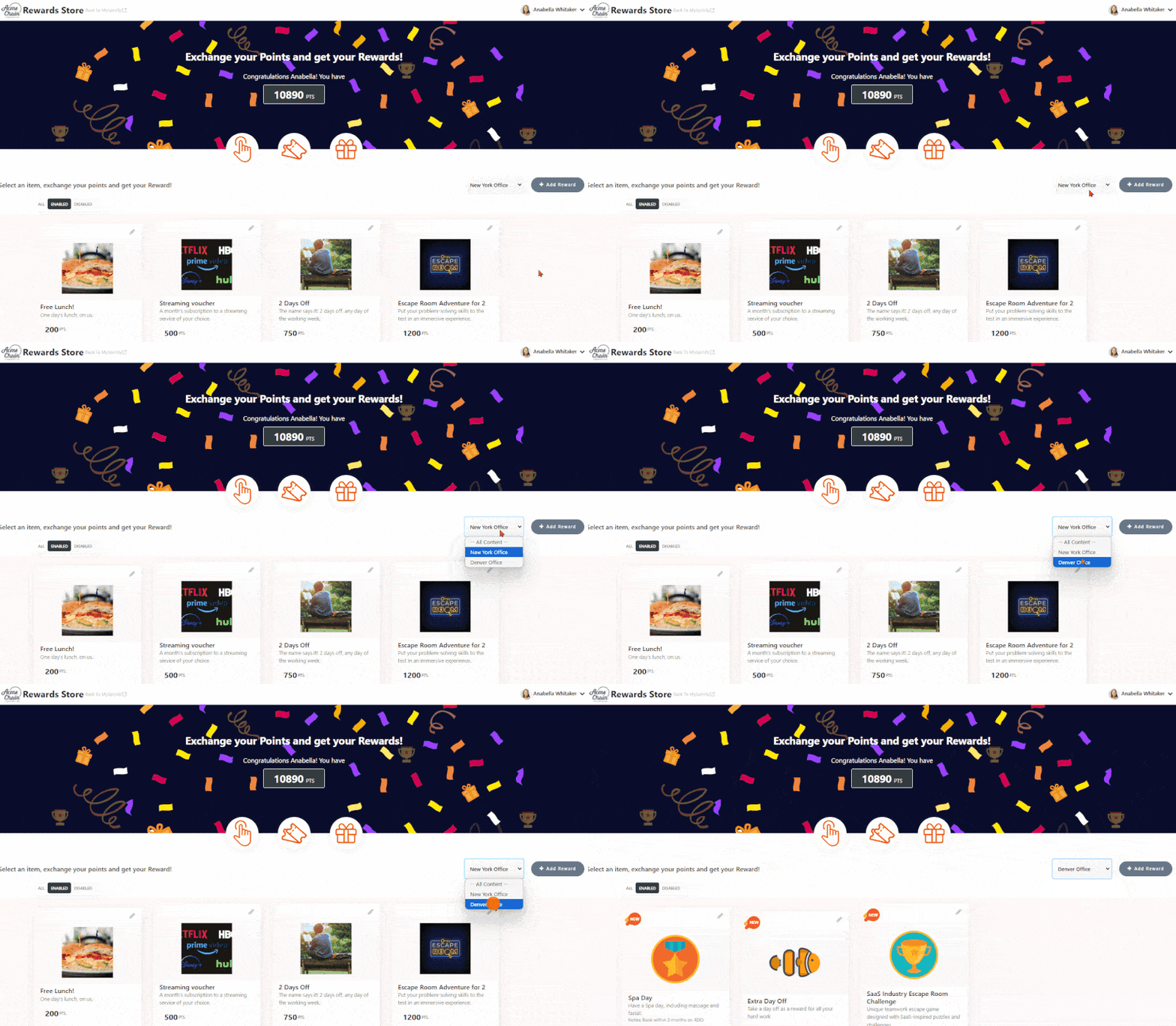
Tangible rewards provide physical or monetary value, making them highly motivating for employees. These rewards are easy to quantify and can directly impact employee satisfaction. Examples include:
- Gift Cards: Versatile and customizable for individual preferences.
- Extra Paid Time Off (PTO): Rewarding employees with a day or two off for high performance.
- Office Perks: Items like upgraded desk setups, ergonomic chairs, or company swag.
- Financial Bonuses: Direct monetary rewards based on point accumulation, allowing employees to earn extra money as they progress in the point system game.


2. Experiential Rewards
Experiential rewards create lasting memories and can significantly enhance morale. They are particularly effective for fostering a sense of appreciation and team spirit. Examples include:
- Team Outings: Organizing escape rooms, dinners, or adventure activities.
- Training and Development: Access to specialized workshops, certifications, or online courses.
- Travel Opportunities: Fully or partially sponsored trips as a reward for exceptional performance.
Social Recognition Rewards for Brand Loyalty
Social recognition leverages the desire for acknowledgment and status within a group. These rewards are often intrinsic and help create a culture of appreciation. Examples include:
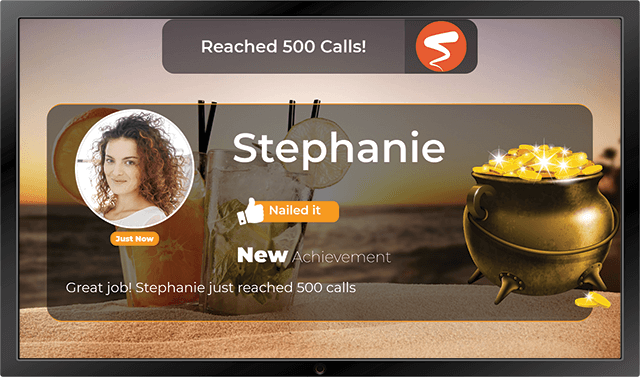
- Ring the Gong: Celebrating achievements with a physical or virtual gong that employees can “ring” when they hit a major milestone. It’s a fun, immediate way to share success across the team.
- Leaderboards: Highlighting top performers in public spaces or on internal platforms.
- Employee of the Month: A title or badge that comes with recognition across the organization. Recognizing a person for their achievements can significantly boost morale and motivation.
- Shoutouts: Public praise during meetings or on internal communication platforms.
In games, a point system can address balance issues by adjusting the difficulty based on each person’s performance, ensuring a more engaging experience for everyone.
4. Virtual Rewards
Virtual rewards are cost-effective and especially relevant for remote teams or digital workplaces. These rewards can be just as impactful as tangible ones when implemented creatively. Examples include:
- Digital Badges: Representing achievements, such as “Top Performer” or “Collaboration Champion.” These badges are typically displayed on a screen, making accomplishments visible and accessible to users.
- In-App Upgrades: Exclusive features or benefits within company tools or platforms. Some platforms offer additional features or benefits through app purchases, allowing users to unlock more functionality or remove limitations.
- Custom Avatars or Themes: Unlockable personalization options for internal gamified platforms.
5. Progress-Based Rewards
Progress-based rewards focus on providing benefits as employees achieve certain milestones. These rewards encourage continuous engagement and effort over time. Examples include:
- Levels and Tiers: Unlocking higher levels of recognition or access to perks as employees reach milestones. Employees can easily figure out their progress and what steps are needed to reach the next milestone.
- Unlockable Content: Exclusive access to new resources, tools, or knowledge for reaching set goals.
- Achievement Milestones: Celebrating significant accomplishments with tailored rewards.
6. Team-Based Rewards
To encourage collaboration and teamwork, team-based rewards align incentives across groups. Examples include:
- Shared Bonuses: Rewards distributed equally among team members for achieving collective goals.
- Team Celebrations: Lunches, happy hours, or team-building activities for hitting targets.
- Group Recognition: Highlighting team achievements in newsletters or town halls.
7. Personalized Rewards
Loyal customers demonstrate that the organization values employees as individuals. Examples include:
- Custom Rewards: Allowing employees to choose their rewards based on accumulated points.
- Anniversary or Birthday Perks: Special recognition or gifts for personal milestones.
- Tailored Incentives: Rewards aligned with an employee’s specific interests, such as concert tickets or books.
By offering a diverse mix of rewards, including memorable activities like ringing the gong, organizations can engage employees at different levels, ensuring sustained participation and enthusiasm in their gamification programs, especially when supported by purpose-built sales gamification software solutions. The right balance between tangible, experiential, and recognition-based rewards helps create a motivational system that drives both individual and organizational success.
Employees are encouraged to share their suggestions for personalized rewards, helping ensure the program meets their individual needs.
8. Fixed Action Rewards
For revenue-focused teams, pairing fixed incentives with a SaaS sales gamification platform to boost performance lets you tie every action to visible progress toward targets.
Fixed Action Rewards offer clear, predictable incentives for customers, such as loyalty programs, frequent flyer miles, and punch cards. These rewards tap into Development & Accomplishment, Ownership & Possession, and Scarcity & Impatience, motivating customers to engage frequently and build loyalty. Often, customers must wait to accumulate enough actions or points before earning their next reward, which builds anticipation and enhances the overall experience.
9. Sudden and Random Rewards
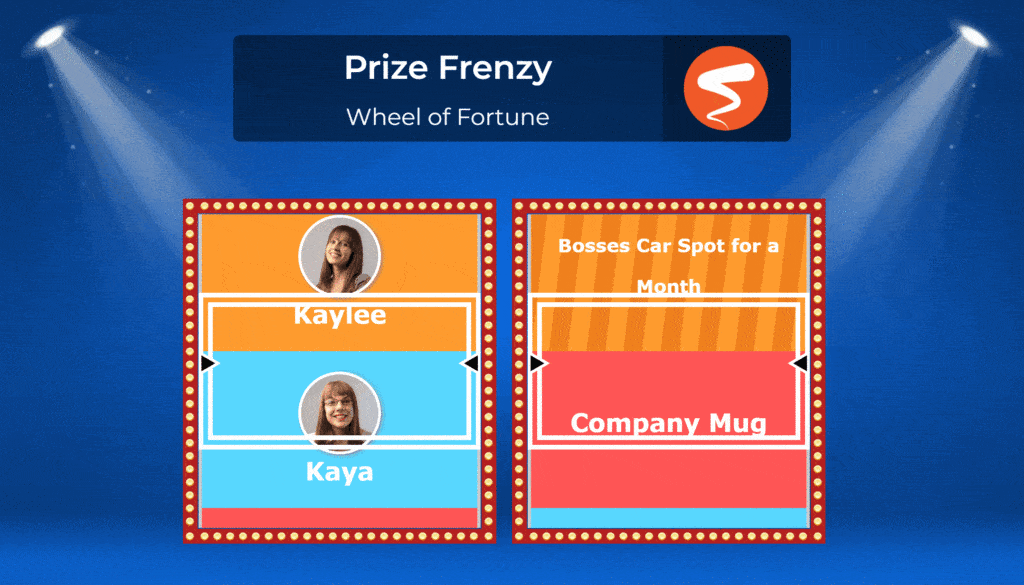
Sudden and Random Rewards add surprise and excitement to loyalty programs. Sudden Rewards are unexpected bonuses, like surprise discounts or free gifts. Random Rewards depend on completing actions but offer unknown prizes, creating anticipation.
Both types increase engagement and loyalty by making the experience dynamic and enjoyable, encouraging customers to keep interacting with the brand. Finally, when a customer receives a sudden or random reward, it marks an exciting culmination of their participation in the point system game.
How to apply gamification points to reward users?
Gamification points offer flexible ways to reward users, especially when they’re embedded directly into tools your team already uses, like a gamification solution integrated with Salesforce. Loyalty program gamification provides clear and predictable incentives for actions, making engagement fun. Your creativity is key to designing scoring conditions and objectives that keep users motivated. Setting a specific target for users to aim for, such as reaching a certain score or achievement, can make the point system game more engaging and encourage strategic thinking.
Think about rewarding customers for different actions and assigning points accordingly. For example, board games often use unique scoring rules, like localized conditions on specific board areas, adding strategy and variety. Each round in a board game represents a turn or phase where players can earn or lose points, and making the wrong move during a round can have significant consequences for your overall score. The act of play is central to gamification, as users actively engage with the system to achieve their goals. In some games, points are awarded based on whether the game lasts more or less than half an hour, emphasizing the importance of time management. In darts, for instance, the game can end on a double, requiring players to plan their final moves carefully.

Score tracking apps are designed to be user-friendly, often featuring large fonts and colorful displays to make it easy for both adults and children to understand the current scores. These apps help you count and tally points as the game progresses, ensuring accuracy. In sports like basketball, each free throw from the line is worth one point, and every point can matter in close games. Missing a free throw or making the wrong decision at the line can change the outcome.
In a gamification program, each post can serve as an update or entry documenting progress and design decisions, while real-time data from your existing tools can be surfaced through Spinify integrations with 100+ apps. Points systems are also used outside of games, such as in driving, where accumulating too many points on your record can lead to losing your license or being restricted to driving only to school or work. In some games, if a vehicle is destroyed, it is considered dead and cannot be used again unless you can fix or recover it through specific mechanics. And sometimes, you might have that one guy on your team who always finds a way to turn things around.
Measuring the Effectiveness of Gamification
Implementing gamification is just the start—measuring its impact ensures it benefits employees and the organization. Score tracking apps simplify scorekeeping, letting players focus on playing rather than manual counting. Unlike traditional pen and paper methods, digital scorekeeping apps offer greater convenience, accuracy, and accessibility. Many of these apps are completely free and ad-free, providing a distraction-free experience with no ads interrupting gameplay or scoring. Download a user-friendly score tracking app to make keeping score easier and more efficient. These apps often support multiple scoreboards, customizable team names, and color coding for clarity and organization.
By combining data and feedback, you can assess if gamification boosts engagement, motivation, and productivity, particularly for distributed staff using a sales gamification platform for remote teams. User-friendly apps with large fonts and colorful screens help all users easily track total scores and progress.
1. Participation and Engagement Rates
- Track how many employees actively participate in the gamification program to assess the effectiveness of loyalty strategies.
- Monitor engagement metrics, such as the frequency of login to the platform, the number of actions completed, or points earned.
- High participation and engagement indicate that employees find the program motivating and enjoyable.
2. Performance Metrics
- Compare performance data before and after implementing gamification. For example:
- Sales Teams: Measure increases in sales, closed deals, or revenue.
- Customer Support Teams: Assess improvements in response times or ticket resolution rates.
- Training Programs: Track course completion rates and knowledge retention scores.
- Ensure that all measurements are correct and data is accurately recorded to properly evaluate the impact of the point system game.
- Identify whether gamification helps employees achieve their goals more efficiently.
3. Goal Achievement
- Evaluate whether employees are meeting the objectives tied to gamification. This might include completing specific tasks, hitting milestones, or reaching KPIs.
- Review goal progression to see if gamification accelerates achievement timelines.
4. Employee Feedback
- Collect qualitative data through surveys, focus groups, or one-on-one discussions.
- Ask employees how they feel about the gamification program: Is it motivating? Does it help them stay focused? Are the rewards meaningful?
- Take time to hear employee feedback and suggestions, as actively listening can reveal valuable insights to improve the point system game.
- Use feedback to identify areas for improvement or expansion.
5. Retention and Turnover Rates
- Measure employee retention rates before and after introducing gamification. Engaged employees are more likely to stay with the organization.
- If turnover decreases, it may signal that gamification contributes to a positive work environment. However, if engagement remains low, retention rates can get worse, leading to higher turnover.
6. Productivity Levels
- Analyze productivity metrics to determine if employees are completing more tasks or working more efficiently after gamification is introduced.
- Break down productivity data to identify which gamified elements within the point system game are most effective at driving improvements.
- Look for patterns where gamified elements drive measurable increases in output.
7. Collaboration and Team Dynamics
- Observe how gamification impacts teamwork. Metrics such as collaboration frequency, peer recognition, or team-based goal achievement can provide insights into whether gamification fosters stronger team connections.
8. Reward Redemption Rates
Monitor how often employees redeem their points or rewards. A high redemption rate indicates that rewards are both attractive and attainable, keeping employees motivated. Employees may feel like they are paying with their accumulated points to unlock desired rewards, which adds a strategic element to their choices and engagement in the point system game.
9. ROI (Return on Investment)
- Assess the financial impact of gamification by comparing the cost of implementation (platform, rewards, etc.) with the tangible benefits, such as increased revenue, reduced churn, or lower training costs.
- Calculate the ROI to determine whether the program delivers measurable business value.
10. Adaptability and Scalability
- Evaluate how well the gamification program adapts to changing needs or scales with your growing workforce.
- Identify if the program continues to engage employees over time or requires updates to maintain effectiveness.
By combining quantitative metrics with qualitative insights, you can determine whether gamification is achieving its intended purpose: increasing employee engagement, motivation, and productivity while contributing to organizational success. Regularly reviewing these measurements ensures that your gamification strategy evolves to meet both employee and business needs.
Spinify Makes Gamification Simple
Gamification is a proven way to engage employees, boost productivity, and build a positive workplace culture. Rewarding employees with points recognizes achievements, celebrates progress, and fuels motivation.
Spinify simplifies gamification with customizable leaderboards, flexible points systems, and meaningful rewards, all built by the team behind Spinify and showcased in depth in our gamification demo center. Whether driving sales, improving collaboration, or enhancing training, Spinify motivates teams and aligns efforts with business goals.
Easily track performance, celebrate milestones, and keep your team excited about progress. Ready to transform your workplace? Spinify is your solution to reward, recognize, and inspire employees like never before. Let’s get started! 🚀
Our user-friendly gamification tools boost performance and make work fun.
Book a demo to see how we simplify your gamification journey.
Final Thoughts: A well-designed point system game drives engagement and creates a culture where employees feel valued and motivated. By focusing on winning outcomes, both employees and organizations benefit from increased success and rewards. Investing in a strong point system game inspires lasting positive change in your workplace.