The real estate industry has always been driven by performance. Whether it’s generating leads, closing deals, nurturing client relationships, or building a strong referral network, success depends on consistency, motivation, and healthy competition.
Yet, many real estate agencies still rely on traditional incentives like commissions and annual awards to motivate their teams. While these remain important, they often fail to provide the day-to-day engagement needed to keep agents motivated throughout long sales cycles.
This is where gamification is changing the game.
By introducing game-inspired elements such as leaderboards, challenges, achievements, points, and real-time recognition into everyday workflows, real estate businesses can create a more engaging environment that encourages consistent performance, strengthens team culture, and ultimately drives better business outcomes.
In this article, we’ll explore how gamification is reshaping the real estate industry and why more agencies are using it to inspire agents, improve productivity, and boost results.
What Is Gamification?
Gamification is the application of game mechanics to non-game activities to encourage participation, motivation, and positive behaviors.
Rather than turning work into a game, gamification makes progress more visible and rewarding by incorporating elements such as:
- Live leaderboards
- Achievement badges
- Points and rewards
- Sales competitions
- Progress tracking
- Milestone celebrations
- Team challenges
- Instant recognition
Research suggests that when implemented thoughtfully, gamification can improve engagement, motivation, and learning outcomes across many industries because it taps into intrinsic motivators such as achievement, mastery, and recognition.
Why the Real Estate Industry Is Perfect for Gamification
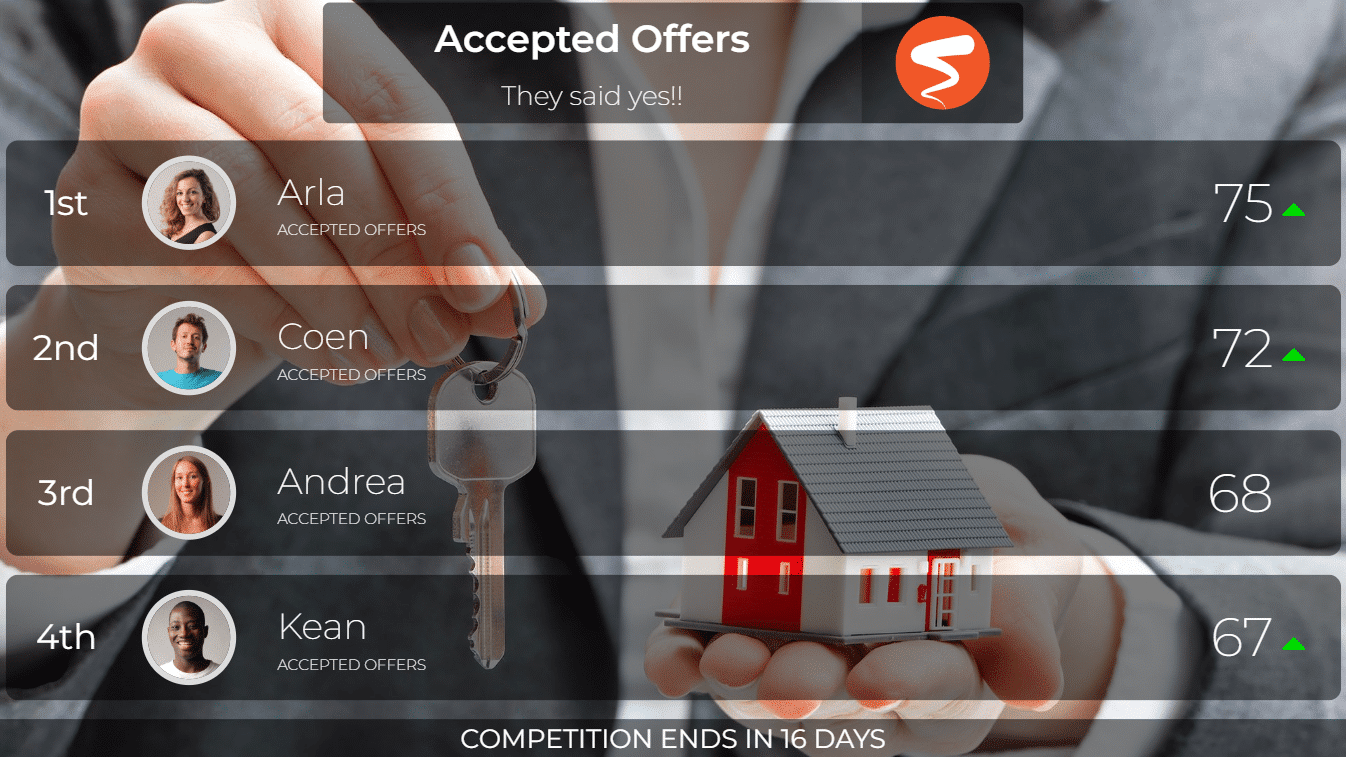
Real estate is inherently competitive.
Agents are constantly balancing multiple priorities, including:
- Prospecting for new clients
- Booking property appraisals
- Hosting open homes
- Following up with buyers
- Negotiating offers
- Closing transactions
- Building referral networks
Many of these activities happen long before a sale is completed.
Gamification helps keep agents motivated by rewarding the behaviors that ultimately lead to successful outcomes, not just the final sale.
This creates momentum throughout the entire sales pipeline.
How Gamification Can Boost Motivation and Improve Agent Performance
One of the biggest challenges in real estate is maintaining motivation during lengthy sales cycles, alongside other common problems like time management, competition, and administrative overload that can stall performance for many real estate agents.
A property may take weeks or months to sell, leaving little opportunity for immediate recognition.
Gamification fills this gap by celebrating progress along the way.
For example, agents can earn recognition for:
- Booking listing appointments
- Generating qualified leads
- Conducting buyer inspections
- Securing positive client reviews
- Completing follow-up calls
- Growing referral pipelines
Frequent recognition keeps agents engaged and reinforces the daily habits that contribute to long-term success.
Encouraging Healthy Competition
Competition has always been part of real estate.
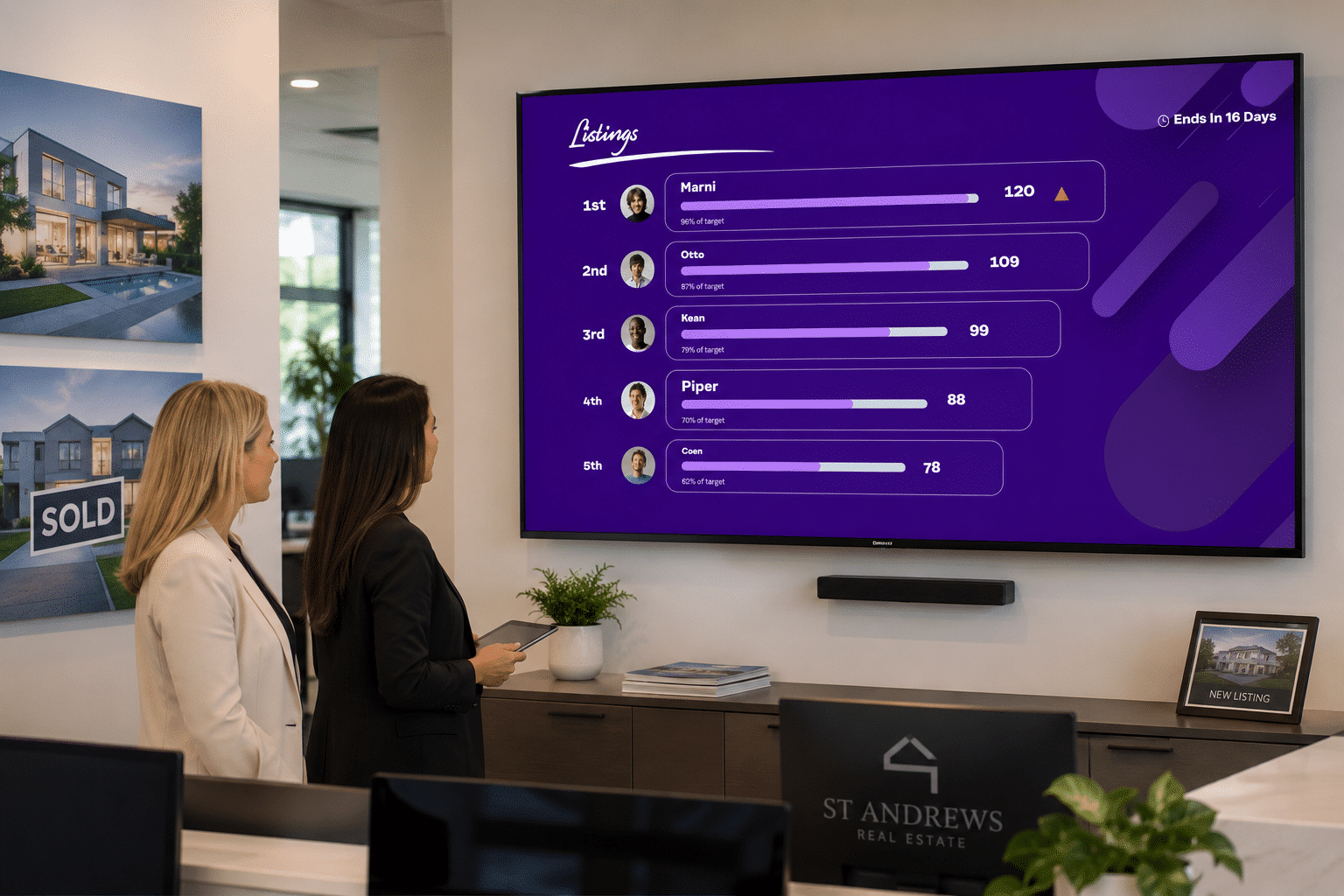
However, traditional performance boards often focus only on total sales, leaving many agents feeling disconnected if they’re not among the top performers.
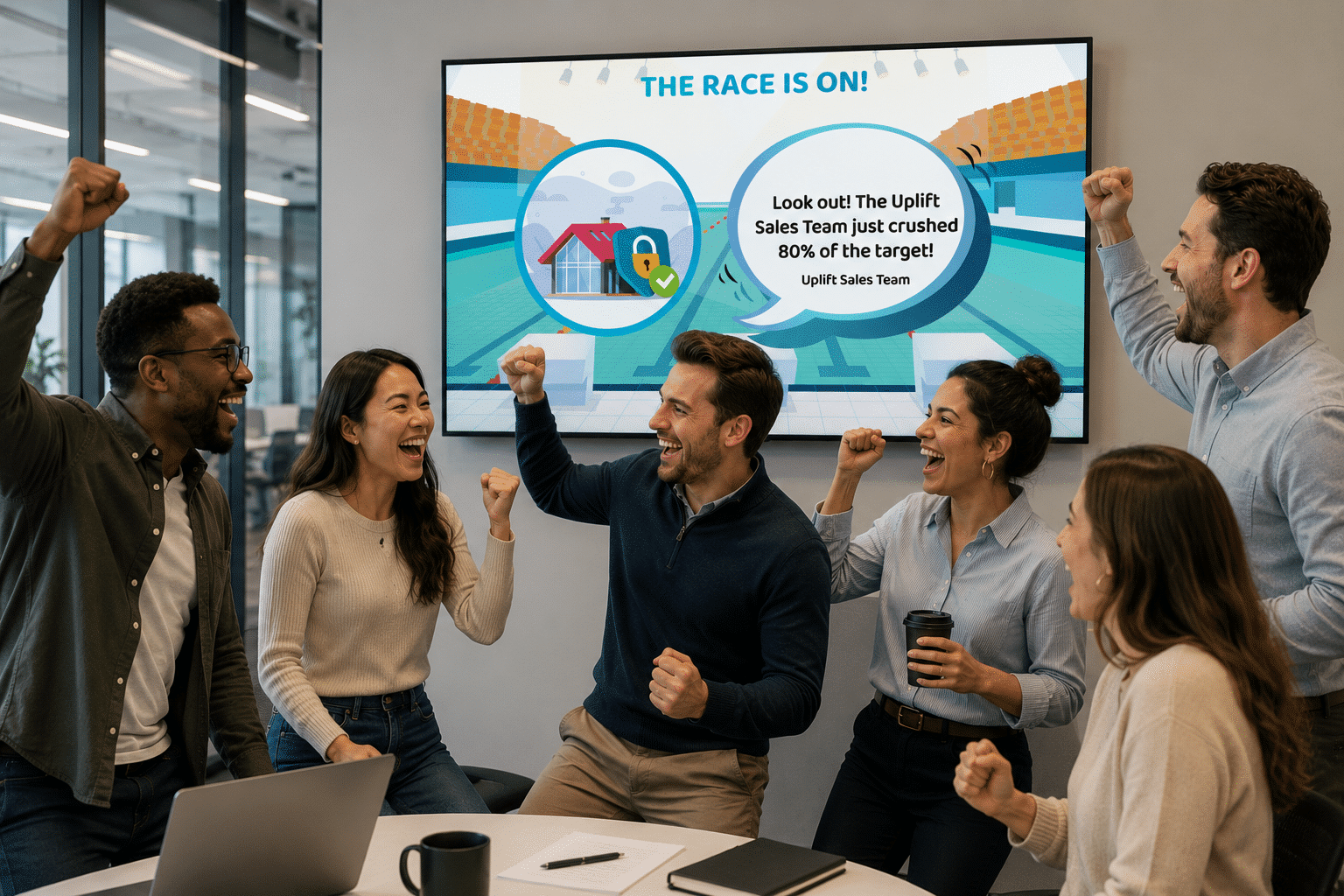
Gamification introduces more inclusive ways for agents or teams to compete beyond total sales.
Instead of rewarding only revenue, agencies can recognize achievements such as:
- Most new listings
- Highest number of appraisals
- Fastest response times
- Most client reviews
- Best auction attendance
- Most improved performance
- Highest referral activity
These formats can work especially well for large groups.
By creating multiple opportunities to succeed, agencies encourage broader participation and stronger team engagement.
Making Performance and Progress Tracking Visible in Real Time
Visibility is one of gamification’s greatest strengths.
Instead of waiting until the end of the month to review performance, agents can see their progress every day.
Real-time dashboards provide instant feedback on key performance indicators such as:
- Listings secured
- Open homes completed
- Buyer appointments
- Vendor meetings
- Contracts exchanged
- Calls made
- Lead conversions
This allows agents to adjust their efforts while campaigns are still active rather than after opportunities have passed.
Building Better Habits Through Daily Challenges
Success in real estate is built on consistency.
Daily prospecting, timely follow-ups, and relationship building often determine long-term performance.
Gamification reinforces these habits by using a clear schedule of achievable daily or weekly challenges that support better time management.
Examples include:
- Make 25 prospecting calls today.
- Book three appraisal appointments this week.
- Follow up with every open-home attendee within 24 hours.
- Request five client reviews this month.
- Complete all scheduled CRM updates.
Visual scheduling methods used in project management are also widely adopted, with GanttPRO used by over 800,000 project managers worldwide and 350,000 businesses praising Gantt charts for project management, much like how dedicated sales goal tracker tools for KPIs give real estate leaders clearer visibility into activity and outcomes.
Breaking larger goals into smaller milestones makes progress feel more attainable and keeps agents focused.
Improving Training and Onboarding
Starting a career in real estate can be overwhelming.
New agents need to learn systems, processes, legislation, negotiation techniques, and local market knowledge.
Gamification helps make onboarding more engaging, and similar methods have also improved outcomes for students in training settings by using structured sales coaching tools and gamified learning to reinforce key behaviors.
Instead of simply completing training modules, new agents can unlock achievements for:
- Completing onboarding courses
- Passing compliance quizzes
- Shadowing experienced agents
- Conducting their first listing presentation
- Closing their first transaction
In training, gamification can improve knowledge retention by 20%.
This approach creates a sense of accomplishment while encouraging continuous learning.
Recognizing More Than Just Sales
Did you know that 80% of millennials prefer on-the-spot recognition? While commissions reward successful transactions, they don’t always recognize the effort that goes into achieving them, so agencies often use other formats, including Employee of the Month-style programs.

Gamification allows agencies to celebrate many forms of success, including structured employee rewards and recognition programs, such as:
- Team collaboration
- Exceptional customer service
- Community involvement
- Professional development
- Mentoring junior agents
- Consistent activity levels
Recognition helps reinforce the behaviors that contribute to a strong workplace culture. Well-designed recognition programs can drive a 10x increase in cross-team engagement while honoring the diversity of contributions people make.
Creating a More Connected Team Culture
Real estate can sometimes feel like an individual sport.
Agents spend much of their time meeting clients, attending inspections, and working independently.
Gamification creates shared experiences that strengthen team culture, especially when supported by dedicated employee recognition software and gamification tools, and even sharing a personal story can help deepen that connection. For example, Two truths, one lie works with 3+ participants and helps teammates connect in a group setting, where a simple personal fact, like a first job, can become one of the building blocks for future conversations. Back-to-back drawing enhances communication skills and can be used as a fun team exercise in a company setting. These activities give each person a chance to discuss a meaningful moment or interest with teammates.
Agency-wide challenges, office competitions, and public recognition help agents connect while encouraging collaboration and maintaining healthy competition.
Celebrating wins together helps build stronger relationships and creates an environment where success becomes contagious.
Using Data to Drive Better Decisions
Modern gamification platforms don’t just motivate, they turn performance data into actionable insights that help leaders support each task more effectively, surface concerns early, and develop better solutions, which is a key reason many agencies choose Spinify as their gamification platform.
Real-time analytics help leaders identify:
- High-performing behaviors
- Engagement trends
- Coaching opportunities
- Training needs
- project-style goal completion rates and resources planning, plus opportunities for new ideas
- Participation levels
Instead of relying solely on end-of-quarter results, managers can use ongoing performance data to support agents throughout the sales process.
Technology Makes Gamification Easy
Technology has made gamification easier to implement than ever, with broader access to online platforms and tools, including specialized sales gamification software solutions designed for real estate and other sales-driven teams.
Starbucks used gamification in 2010 in its customer loyalty program, showing the model works well beyond real estate and even helps drive repeat store visits.
Integrated platforms can automatically track performance, update leaderboards, deliver recognition, and create personalized challenges across a website or mobile site, including private views where appropriate, while improving the user experience without adding administrative burden, especially when they include dedicated real estate sales leaderboards and motivation tools.
Features commonly include:
- Live leaderboards
- Automated competitions
- Mobile notifications
- Performance dashboards
- Goal tracking
- Team challenges
- Recognition feeds
- CRM integrations
These tools also support marketing programs used by leading brands, with each point awarded automatically and tracked across the app experience, helping organizations engage their sales teams with gamification.
Automation allows agencies to spend less time managing incentive programs and more time supporting their teams.
How Spinify Helps Real Estate Teams Stay Motivated
For real estate agencies looking to build a culture of continuous motivation, Spinify provides the tools to bring gamification into everyday workflows.
By combining live leaderboards, real-time recognition, automated competitions, and performance dashboards, Spinify helps agencies apply gamification effectively across everyday workflows to create engaging experiences that celebrate progress, not just completed transactions.
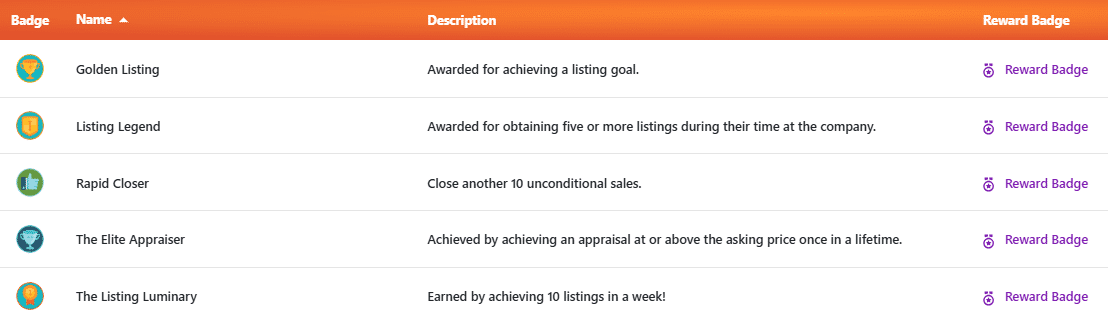
Whether your team is focused on generating more listings, improving follow-up activity, increasing client engagement, or driving stronger sales performance, gamification keeps agents connected to their goals and motivated to perform at their best.
With integrations into popular CRM and sales systems, agencies can track meaningful metrics automatically through a leading solution for tracking progress and recognizing achievements in real time, helping create a more energized and performance-driven workplace. You can explore these features in detail in Spinify’s Demo Center for gamification and performance tools.
Best Practices for Introducing Gamification in Real Estate
To achieve the best results:
- Reward the behaviors that lead to successful transactions.
- Make goals clear, measurable, and achievable.
- Celebrate progress frequently, not just final outcomes.
- Choose challenge formats that fit your team, and gauge buy-in before rollout, since different types work better for different strengths and roles.
- Use real-time performance tracking to maintain momentum.
- Refresh challenges regularly to keep engagement high.
- Recognize collaboration alongside individual achievement.
- Review performance data regularly and adapt your strategy.
Some agencies start with a written set of rules, goals, or recognition criteria so everyone understands the process. A pilot challenge can help test an idea before scaling it.
A successful gamification program evolves alongside your agency’s goals when it is set up well from the beginning and keeps motivation high throughout the year, especially as goals, resources, and priorities change.
Frequently Asked Questions
What is gamification in real estate?
Gamification applies game-inspired elements such as leaderboards, points, badges, and challenges to everyday real estate activities to increase motivation, engagement, and performance, often through a website, app, or internal platform where a user can see each point, badge, and challenge in real time.
How does gamification help real estate agents?
Gamification provides regular recognition, encourages healthy competition, tracks progress in real time, and rewards the daily activities that lead to successful property sales, which helps agents manage each task more effectively and stay focused on priorities.
Can gamification improve team culture?
Yes. Shared challenges, public recognition, and collaborative competitions help strengthen relationships between agents while creating a more positive and engaging workplace. Even lighter gamified activities can help, since sharing personal milestones, such as a first job story, gives teams another way to connect.
What activities can be gamified in real estate?
Almost any measurable activity can be included, including prospecting calls, listing appointments, buyer inspections, client reviews, referrals, onboarding, training completion, project milestones, follow-up work, and any other measurable task-based activities; gamified options can also include role-play exercises where agents play through scenarios. Teams can also do a build challenge where they create a structure to protect a raw egg, with each round becoming more complex.
How do agencies measure the success of gamification?
Success can be measured through participation rates, activity levels, employee engagement, lead generation, listing growth, sales performance, client satisfaction, and retention, with agencies also reviewing engagement and participation among employees across each group or office location.
Final Thoughts
The real estate industry thrives on energy, relationships, and consistent performance. Gamification enhances all three by turning everyday activities into engaging, measurable achievements that keep agents motivated throughout every stage of the sales journey.
Rather than relying solely on end-of-month results or annual awards, agencies can create a culture of continuous recognition, healthy competition, and ongoing improvement.
When implemented strategically, gamification doesn’t just make work more engaging; it helps build stronger habits, improve performance, and create high-performing teams ready to succeed in an increasingly competitive market.
If you’re ready to motivate your agents, improve engagement, and drive better business outcomes, book a demo to discover how Spinify can help your real estate team unlock its full potential.