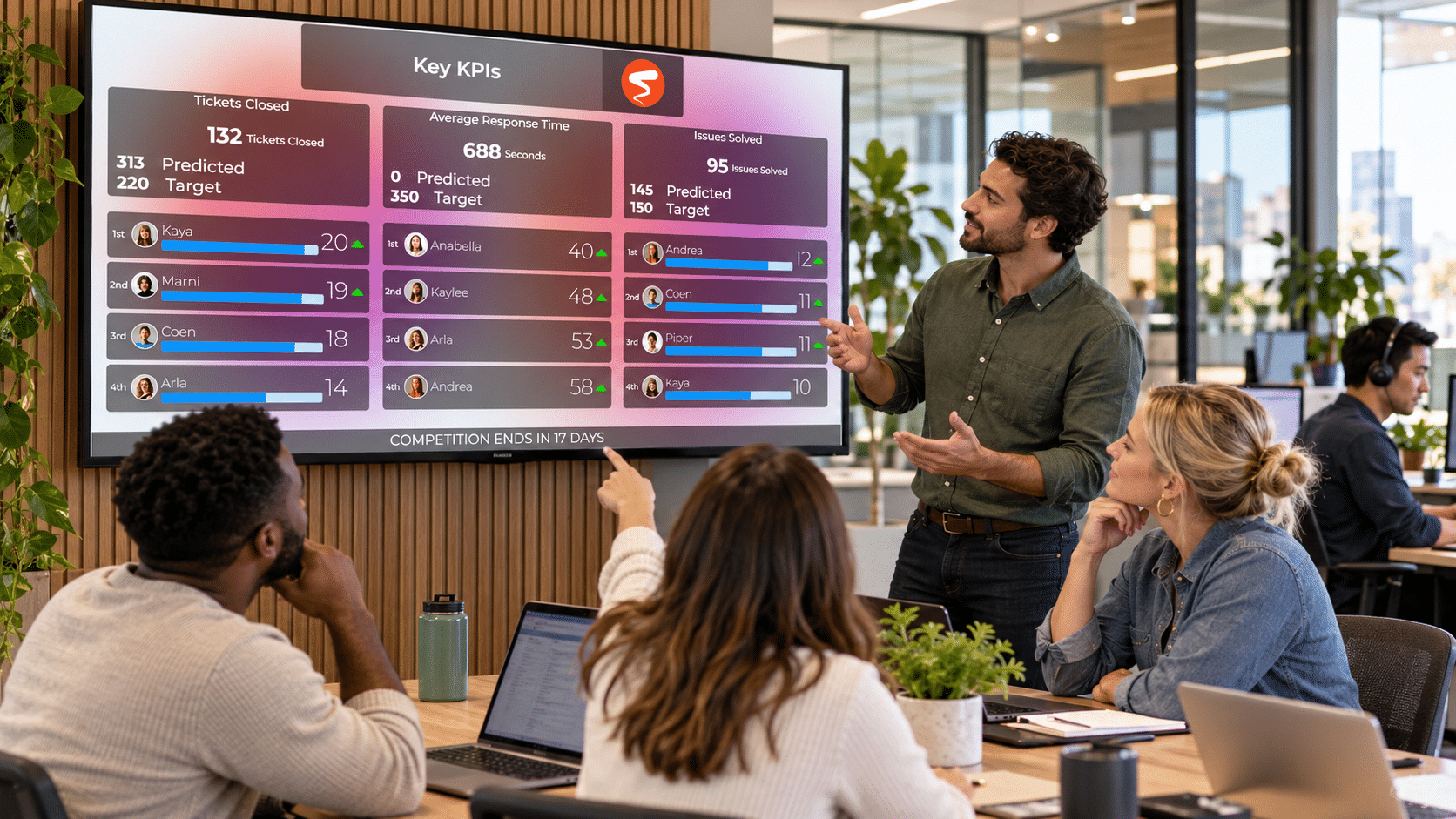
Sales gamification should do more for teams than just make a leaderboard look lively. It should help them focus on the right work, make progress visible, and reinforce the behaviors that lead to better sales outcomes.
This raises an important question for sales and revenue leaders: how do you prove the investment is working?
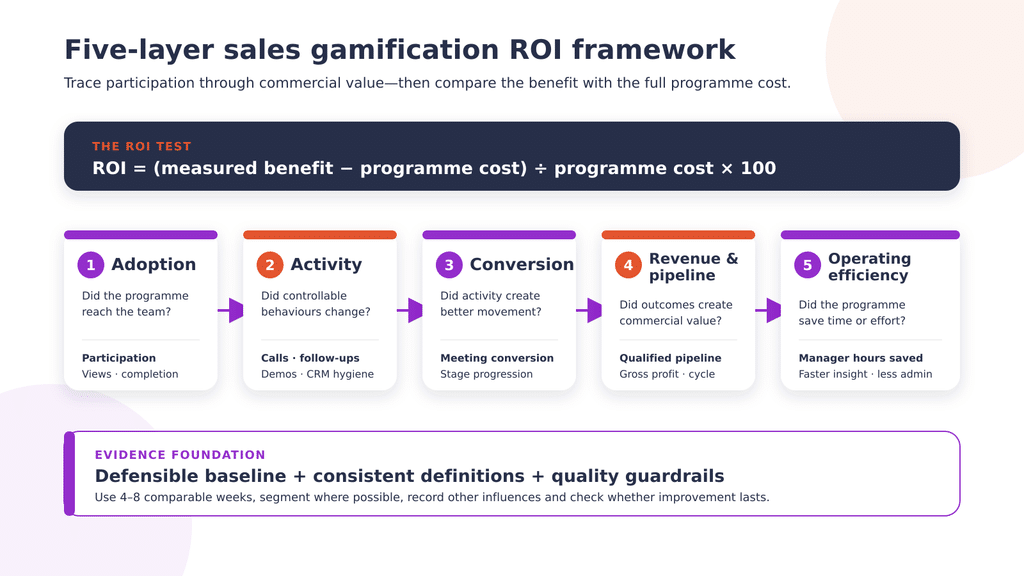
The answer is not a single engagement score or a short-term spike in calls. A useful ROI model connects five layers: adoption, activity, conversion, revenue, and operating efficiency. It also compares performance against a credible baseline so normal seasonality or pipeline changes are not mistaken for impact.
What Sales Gamification ROI Means
Sales gamification ROI compares the measurable value created by a gamification program with the full cost of running it.
A basic formula is:
ROI = (measured benefit − program cost) ÷ program cost × 100
The arithmetic is simple. Defining “measured benefit” is the real work.
For some teams, the main benefit may be more qualified meetings. For others, it may be better CRM hygiene, faster follow-up, improved conversion, or less time spent by managers assembling reports and manually running contests.
Before launching a competition, decide which commercial constraint it is meant to change.
Start With One Business Problem
Avoid launching a competition with vague or broad goals, such as “increasing motivation.” Obviously, motivation matters, but it is difficult to value directly and can produce misleading conclusions.
Start with a specific operational problem, such as:
- Too few qualified meetings are being booked.
- Follow-up activity drops after the first contact.
- Opportunities are missing required CRM fields.
- New representatives take too long to establish consistent habits.
- Managers discover performance gaps too late in the month.
- Wins and productive behaviors are not recognized across remote teams.
The narrower the problem, the easier it is to select the right metric and judge whether the program worked.
Measure Five Layers of Impact
1. Adoption
At its core, adoption is about people. It tells you whether your sales gamification program is genuinely becoming a helpful, natural part of your team’s day-to-day rhythm or just another tab they ignore. When rep adoption is strong, gamification stops feeling like an extra task and starts feeling like a shared heartbeat for the team.
Track measures such as:
- Percentage of eligible representatives participating
- Percentage viewing the leaderboard or progress display
- Competition completion rate
- Number of active participants by week
- Participation across teams, territories, and tenure bands
Think of low adoption as an early warning signal. If your team isn’t logging in, checking the board, or engaging with the dynamic, even the most beautifully designed incentive structure won’t move the needle.
2. Sales Activity
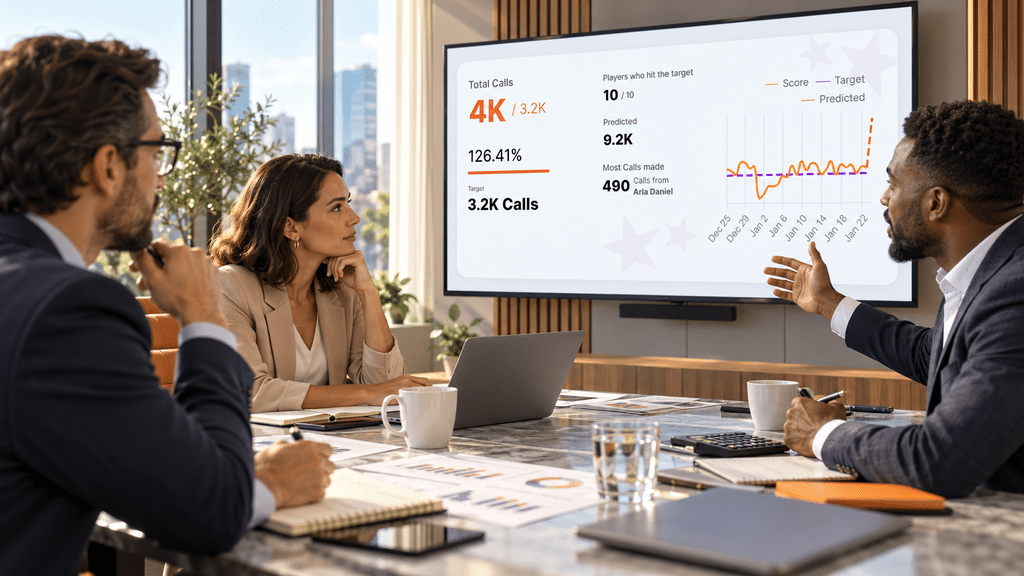
When it comes to tracking sales activity, focus on the actions your team can directly control day in and day out. Measuring outcomes is important, but driving consistency around the right foundational habits is what actually gets you there.
Here are a few high-impact activity metrics worth keeping an eye on:
- Calls completed
- Meaningful conversations
- Follow-ups completed within the agreed timeframe
- Demos booked
- Opportunities advanced with required CRM information
- Proposals delivered
A word of caution, though: never celebrate raw volume without keeping quality top of mind. High call numbers mean very little if connect rates plummet, prospect qualification suffers, or your customer experience takes a hit. Always pair activity goals with realistic quality guardrails to make sure you’re building real pipeline, not just noise.
This is where real-world results can help put things into perspective. Spinify has reported a 43% increase in completed sales activities among customers using its gamification tools. While increased activity alone doesn’t guarantee stronger sales outcomes, it provides a useful starting point for measuring whether greater visibility and recognition are helping teams build more consistent habits.
3. Conversion
Conversion metrics tell you if the extra effort is actually paying off. It’s one thing to see a massive spike in call volume or outreach, but if those touchpoints aren’t moving prospects forward, you’re just spinning your wheels. Measuring conversion helps you understand whether your gamification program is sharpening your team’s effectiveness or just making them busier.
Key conversion indicators to keep an eye on include:
- Call-to-conversation rate
- Conversation-to-meeting rate
- Meeting-to-opportunity rate
- Opportunity-to-proposal rate
- Proposal-to-close rate
- Stage progression time
Tracking this layer protects you from a common trap: celebrating a surge in activity that ultimately creates zero downstream value for the business.
4. Revenue and Pipeline
At the end of the day, revenue is the ultimate goal, but it’s also a lagging indicator. Closing deals takes time, and results are heavily influenced by factors like deal size, target territory, marketing support, market demand, and natural seasonality.
Depending on the program, measure:
- Qualified pipeline created
- Closed-won revenue
- Average deal value
- Sales-cycle length
- Expansion revenue
- Attainment against an agreed target
Where the sales cycle is long, use leading indicators during the program and review revenue outcomes later.
For example, Ray White Canberra reported a 10% increase in property listing activity alongside 19% growth in fee revenue after introducing Spinify. It’s a useful example of why measuring both activity and commercial outcomes matters. Increased activity can be an encouraging early indicator, but connecting those improvements to actual revenue growth gives sales leaders a much clearer picture of business impact.
5. Operating Efficiency
The true value of gamification often shows up in the hours it gives back to your leadership team. When you automate manual tracking and reporting, managers spend less time wrestling with spreadsheets and more time doing what actually moves the needle: coaching reps, unblocking deals, and supporting their team’s growth.
Key efficiency metrics to track include:
- Manager hours spent preparing reports and leaderboards
- Time required to launch and administer a competition
- Time between an activity occurring and the team seeing recognition
- Time taken to identify representatives who need coaching
- Manual data corrections required
When you turn administrative overhead into productive coaching time, those efficiency gains become a powerful, highly defensible addition to your ROI model.
Establish a Defensible Baseline
Record the baseline before the program begins. A practical baseline usually covers four to eight comparable weeks, adjusted for obvious anomalies such as holidays, territory changes, or a major campaign launch.
Capture the same metrics you will use during and after the program. Segment the data, where possible, by team, tenure, or territory so that a change in team composition does not distort the results.
The strongest evaluation uses a comparable team or staggered rollout. If that is not practical, compare the program period with the baseline and clearly record other events that might have influenced performance.
Calculate the Program’s Value
Imagine a program designed to increase the number of qualified meetings.
During a six-week baseline, the team averages 80 qualified meetings. During the six-week program, the average is 96. After confirming that qualification rules and team capacity remained consistent, the team attributes 16 incremental meetings to the program.
If historical data shows that each qualified meeting contributes an expected amount of gross profit, that value can be used to estimate the program benefit. Add measurable manager time savings, then subtract software, rewards, and administration costs.
Use conservative assumptions. An ROI model is more credible when it separates observed results from estimated downstream value.
Avoid These Five Common Measurement Mistakes

Mistake 1: Measuring Only the Top Performer
It’s easy to look at a runaway winner and assume the whole contest was a smashing success. But if your top rep blew past their target while the rest of the team barely engaged, you haven’t moved the operational needle; you’ve just celebrated an outlier. When evaluating impact, zoom out. Pay close attention to participation rates, look at performance across the middle tier of your team, and measure average improvement rather than just who walked away with first place.
Mistake 2: Rewarding Activity With No Quality Guardrail
If you incentivize raw output without setting quality standards, reps will naturally find the fastest path to point collection. That often leads to rushed phone calls, half-baked prospect qualification, and messy CRM records. You should always balance activity targets with conversion thresholds, deal qualification standards, or data accuracy checks so you’re building a genuine pipeline rather than just inflating daily metrics.
Mistake 3: Ignoring Fairness
Nothing drains motivation faster than a competition where the same few senior reps with prime territories win every single time. A single raw leaderboard often disadvantages newer hires or teams managing tougher accounts. Keep things engaging and fair by using individual targets, improvement-based scoring, collaborative team formats, or competitions segmented by tenure level.
Mistake 4: Claiming Causation From a Before-and-After Comparison
Seeing a lift in revenue right after launching a contest feels great, but jumping straight to causation can be misleading. Seasonal buying spikes, fresh marketing campaigns, new pricing models, or shifts in product mix all impact the numbers. Be realistic about external variables, log concurrent business changes, and, whenever possible, use control groups or staggered rollouts to isolate true impact.
Mistake 5: Ending Measurement When the Contest Ends
A short-term performance boost is nice, but long-term habit change is where real ROI lives. Don’t close the book as soon as the winner claims their reward. Keep tracking key behaviors 30, 60, and 90 days out to verify whether productive routines stick once the immediate incentive is gone.

A Practical Sales Gamification Scorecard
Think of this framework as your step-by-step roadmap for building, measuring, and fine-tuning a sales gamification strategy that actually drives results. Whether you are looking to boost daily activity or level up overall pipeline performance, this scorecard helps you keep every layer of your team aligned. Want to dive right in? Feel free to download our template to get started today.
1. Adoption Layer
Purpose: Confirms whether the program successfully engages representatives and becomes part of their daily workflow.
Example Measures: Percentage of eligible representatives participating, daily/weekly active users on leaderboards, competition completion rate, and participation balance across tenure bands.
Operational Tips: Broadcast live leaderboard displays in shared office spaces and on TV screens, stream automated achievements into team channels (e.g., Slack or Teams), and run short-duration sprint competitions to build early momentum.
2. Activity Layer
Purpose: Tracks high-value, controllable behaviors that build pipeline and drive momentum.
Example Measures: Outbound calls completed, qualified follow-ups logged, product demonstrations scheduled, and required CRM fields populated.
Operational Tips: Focus point structures on leading indicators rather than vanity volume. Weight actions based on difficulty or strategic focus, such as assigning extra points for contacting target accounts or executive decision-makers.
3. Quality & Conversion Layer
Purpose: Ensures increased activity leads to real progression through the sales funnel rather than superficial volume.
Example Measures: Call-to-meeting conversion rate, discovery-to-opportunity stage rate, proposal win rate, and deal velocity (days spent per stage).
Operational Tips: Implement strict qualification criteria before awarding competition points for deal advancement. Pair volume metrics with conversion gates, for example, requiring a minimum 20% conversion rate for activity points to qualify.
4. Commercial Outcome Layer
Purpose: Connects behavioral changes directly to business revenue and pipeline growth.
Example Measures: Qualified pipeline generated, total closed-won revenue, average deal size, expansion/upsell revenue, and quota attainment percentage.
Operational Tips: Align competition timing with key commercial cycles (such as quarter-end closes or new product launches). Use weighted scoring models so that closing strategic deals yields higher leaderboard value than standard volume.
5. Operating Efficiency Layer
Purpose: Measures administrative time saved and improvements in management productivity.
Example Measures: Manager hours saved on manual reporting, time required to launch contests, speed of performance gap identification, and reduction in CRM data errors.
Operational Tips: Automate data ingestion directly from your CRM so managers don’t spend hours updating spreadsheets. Use automated triggers and badges to recognize achievements in real time.
6. Sustainability Layer
Purpose: Evaluates whether positive performance habits endure after the incentive period ends.
Example Measures: Activity baseline maintenance 30–60 days post-contest, sustained CRM compliance rate, rep retention, and long-term quota achievement.
Operational Tips: Avoid abrupt contest drop-offs by transitioning short-term competitions into ongoing habit milestone badges. Audit baseline metrics regularly to verify long-term behavior change.
How Spinify Supports Measurement
Spinify connects sales activity from the systems teams already use every day. By turning day-to-day activities into dynamic leaderboards, interactive competitions, and instant team celebrations, progress becomes clear and engaging for everyone involved. Sales managers can effortlessly tailor key metrics and targets to their team’s specific goals, track real-time progress, and spot coaching opportunities early, well before the end of the quarter.
And that visibility can make a measurable difference. Spinify has reported a 208% improvement in KPI tracking and visibility, highlighting the value of making performance data easier to access and act on. When managers can see how their teams are progressing against key metrics, they’re better equipped to recognize positive behaviors, identify performance gaps, and make timely coaching decisions.
Of course, technology is only part of the equation. Powerful software works best when paired with thoughtful strategy. The most impressive results always come from targeting a genuine business challenge, setting up a fair and transparent scoring structure, and celebrating performance improvements across the entire team.
Ready to see how it can transform your team’s daily workflow? Explore Spinify’s sales gamification software, check out our demo center, or see how sales leaderboards work.
Frequently Asked Questions
How long should a sales gamification pilot run?
It should be long enough to influence the selected behavior and observe a relevant downstream outcome. Short activity-focused programs may produce a useful signal in several weeks, while pipeline or revenue outcomes may require a later review aligned with the normal sales cycle.
What is the best KPI for sales gamification?
There is no universal best KPI. Choose the measure closest to the team’s current constraint, then pair it with a quality or conversion guardrail. For example, a meeting-booking competition should also monitor qualification or show rates.
Should sales competitions reward activity or revenue?
It depends on the role and objective. Activity measures give representatives more direct control and create faster feedback. Revenue measures are commercially meaningful but can be distorted by territory, deal timing, and account ownership. Many programs use both, with appropriate weighting and fairness rules.
How can teams prove that gamification caused an improvement?
Use a clear pre-program baseline, consistent metric definitions, and, where possible, a comparison team or staggered rollout. Record other changes that could affect performance and describe conclusions conservatively.